Ideology vs Practicality
Level 2 - Value Investor

Welcome Avatar!
A principle is not a principle until it costs you something.
Everyone loves to talk a big game about how they would handle situations that challenge their values, but when the numbers on the cheques get bigger, bottom lines start to take over.
A principled path is surely an honorable one, but from a business perspective it may not always be the winning one. Principles can cost you - and that is by design.
A real ideological split has opened in crypto in recent years. The approval of the Bitcoin ETF in 2024 set off a chain of events merging the traditional financial world with crypto.
The TradFi market brings with it a flood of capital that vastly out scales a purely crypto native environment. It now means there are two paths for people entering the crypto “industry.”
You have the business path, which prioritizes user demands, profitability, competitiveness, product, token performance and scaling to new markets.
Or you have the values driven path, which focuses on open source, privacy, security and decentralization.
Builders and investors have now created a clear separation between commercial crypto and cypherpunk ideals.
These differences propagates across governance, funding, token design, developer incentives, regulatory posture and culture.
The best active comparison of this dynamic is Ethereum versus Hyperliquid.
Hyperliquid uses delegated proof of stake with a top-24 validator set by stake, fee-linked incentives, foundation validator delegation, and explicit market operator roles for builders in HIP-3 perpetuals. It is fast, cheap and hungry to capture market share from centralized competitors. Its token receives direct value capture from the protocol’s huge fees.
Ethereum governance remains much more socially driven. The EF says it does not control Ethereum, governance is decentralized and not rigidly defined, and protocol change requires wide social and technical coordination across stakeholders and client teams.
Ethereum focuses on core principles like ensuring no one can censor your transactions, keeping software open to the public, and protecting privacy. They are willing to sacrifice speed and token performance to maintain these values. It is an attempt to constitutionalize a large blockchain ecosystem before scale, institutions, and regulatory pressure corrode the properties that made it meaningful in the first place. To maintain these standards the Ethereum Foundation was willing to lose some of its most senior / longstanding contributors (as covered here). These departures have fed a wider debate about transparency, culture and direction inside the EF.
The crucial point is that Ethereum’s values path is costly. Its developer incentives still run heavily through grants, ecosystem support, educational onramps, public goods, and the reputation of building the base layer of crypto.
At the same time Hyperliquid has made major strides in proving the business case for crypto. This exerts pressure on Ethereum as contributors, investors, and other stakeholders can clearly compare the two paths. A values-first ecosystem that cannot pay, retain, or coordinate its top talent will lose ground even if its principles are superior.
Hyperliquid wins almost every line a traditional analyst cares about. Revenue, value capture, growth rate, margins, etc. Ethereum wins on the lines that don’t really fit traditional models at all. Things like validator count and neutrality. This is a big driver of ETH’s underperformance as an asset.
Risks, strengths, and plausible outcomes
If the business oriented path dominates crypto, the near term outcome is pretty straightforward. We’ll have better UX, more 24/7 financial products, clearer token value capture, more intense competition with centralized venues and faster access to institutional flows. We can call this “commercial crypto.”
The risks are also quite straightforward. There are still hard tradeoffs among decentralization, security, scalability and high performance execution. Hyperliquid’s design is more decentralized than many detractors will admit, but it still relies on a relatively small active validator set, foundation-led delegation, market rules controlled by the operators and has jurisdiction sensitivity.
A crypto industry dominated by the commercialized model could become very large and very useful while drifting toward more control from corporate-like operators.
If the values-based path dominates, crypto preserves its most defensible core claim: that it offers sanctuary to users who need systems that resist censorship, coercion, surveillance and discretionary exclusion.
Vitalik on Ethereum
On May 24, 2026 Vitalik Buterin published his take on where the Ethereum Foundation is going. He said the EF will become a “smaller ship,” sell less ETH, and prioritize decentralization, privacy, security, and censorship resistance over pure speed as the organization restructures.
He said if he could go back to the late 2000s, he would choose a stricter, more idealistic Google, even if that meant strong veto power for open source hardliners because tech has shifted toward profit, aggressive AI and political pressure, and he believes at least one major player should resist.
Ethereum is successful in a very different way from Hyperliquid. It remains the deepest settlement and collateral layer in crypto, with around $55 billion of DeFi TVL, roughly 35.9 million ETH staked, about 1.1 million active validators, and the largest developer ecosystem in the industry. Its L2 ecosystem has also scaled materially with Ethereum L2 TVL around $45 billion, with very low fees making Ethereum-based applications usable at consumer scale.
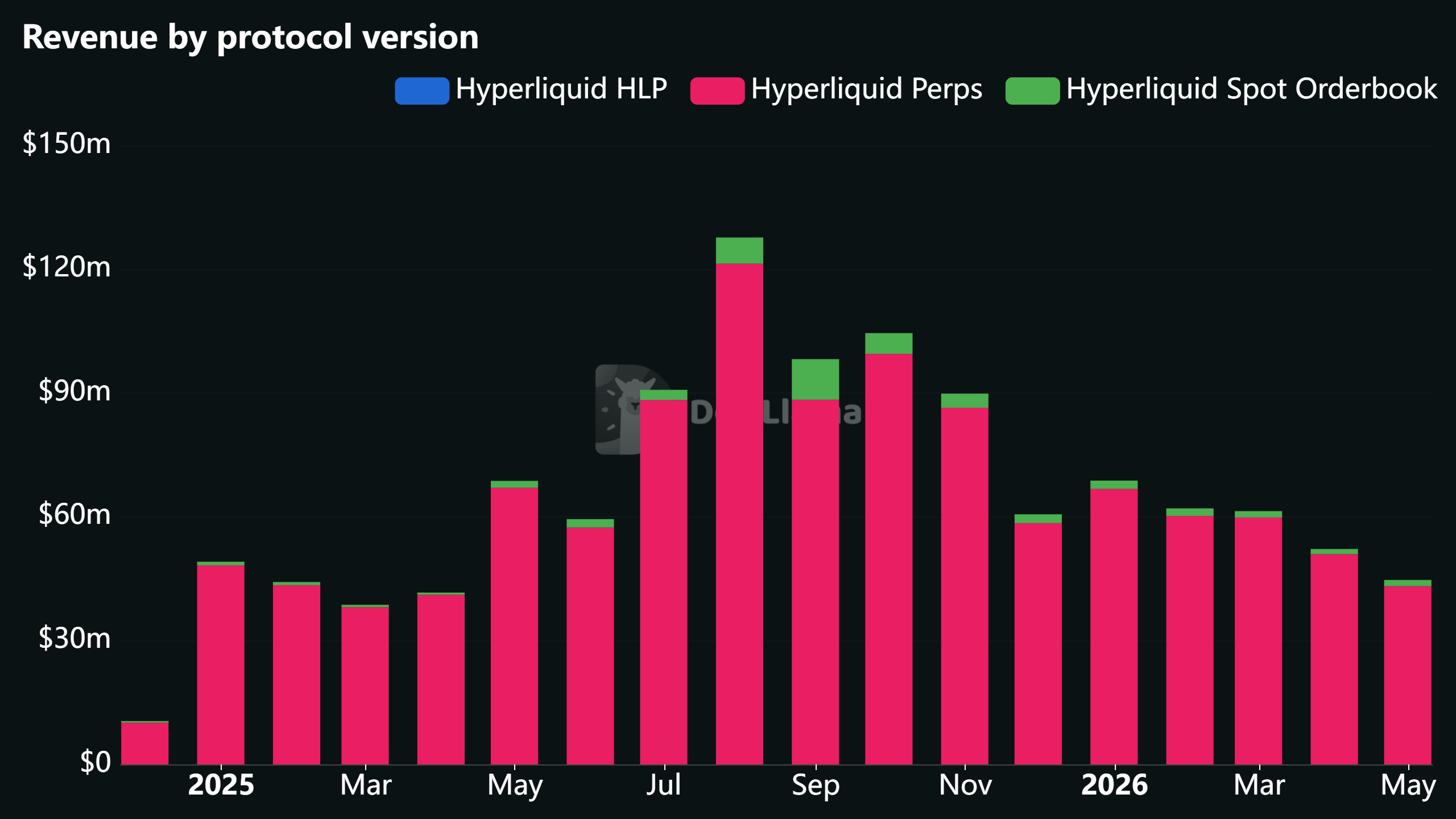
Hyperliquid has generated $185 billion of 30-day perp volume, $52.5 million of 30-day revenue, and about $5.4 billion of TVL across the broader Hyperliquid protocol. It’s the realest onchain business crypto has today. While Hyperliquid does remain dominant, its monthly revenues have been declining alongside broader crypto market weakness.
It is worth being precise about what Hyperliquid’s commercial path trades off. Last year Hyperliquid’s validators voted to manually delist a low cap memecoin called JELLY and close a position at $0.0095 after a trader had opened a short on JELLY and pumped its price on other decentralized exchanges. Validators overrode the market/oracle outcome by settling the market at $0.0095. That is not exactly a flaw for an exchange. Most users want a venue that won’t get drained by a single bad position. It is a very clear cost on crypto principles.
What Principles Buy
Principles buy you a hard earned, well deserved trust premium. The bull case for the values path is that nobody has correctly priced this premium yet.
True neutrality is the most valuable geopolitical asset of the 21st century. If competing sovereign nations or major corporations are going to settle billions of dollars on a public ledger, it has to be one that is credibly neutral. Strict principles also buy long-term developer lock in. Despite the many complaints voiced by Ethereum developers around low compensation and vision, we noticed that many of them stuck around for years. Many of us joined crypto because of the core principles this technology was built on.
The commercial path is also highly vulnerable to coordinated state action. If your network has a CEO-like figure, a small validator set, and a physical corporate footprint, a single coordinated subpoena can shut you down or force KYC on every user. CME and ICE are already urging the CFTC to regulate Hyperliquid. True decentralization is the ultimate legal shield. When you cannot be coerced because no single entity holds the keys, you survive regulatory onslaughts that would cause commercially focused apps to shut down.
The Reality
Ethereum is not entirely “values focused” and Hyperliquid is not entirely “business focused.” Each has their set of principles and business focus. They both exist on a spectrum (of turbo autism).
Ultimately, the market may not force us to choose just one path. The endgame of this ideological split is principles at the bottom, business at the top. In a fully actualized modular blockchain ecosystem, the base layers like Ethereum act as a foundation that is hard to shake.
The friction we are discussing today exists simply because these two philosophies are fighting for the same capital, the same narratives and the same talent. However, the world is more than big enough for both philosophies to exist.
The real risk to Ethereum isn’t the values-based approach in and of itself. A hardline commercial approach would likely bury Ethereum anyway due to a loss of trust. The risk is that Ethereum is taking on all this “philosophical liability” and then potentially not gaining value in proportion to the Ethereum network winning. For example, L2 activity was able to grow without proportionally feeding L1 fee revenue. Ethereum remains a long dated bet on the world coming onchain, whereas business-first protocols are able to drive clear value now.
The TLDR? You allocate to the commercial path for profits, and you allocate to the principled path as your broad sector bet.
If you’re long the crypto sector sign up to be a paid subscriber today to stay on top of the market without spending all day on crypto twitter.
Paid subscribers also get access to:
All of our past posts
Weekly Deep Dive Report
A comprehensive bi-weekly DeFi Roundup
Bi-weekly Q&A sessions with our team
Until next time..

Disclaimer: None of this is to be deemed legal or financial advice of any kind. These are opinions from an anonymous group of cartoon animals with Wall Street and Software backgrounds.
We now have a full course on crypto that will get you up to speed (Click Here)
We offer the Prediction Markets module on a standalone basis (Click Here)
Security: Our official views on how to store Crypto correctly (Click Here)