Onchain Yield Field Guide
Level 3 - Virgin DeFi Analyst

Welcome Avatar!
We commonly get asked about where to find safe, easy and high yields onchain in crypto.
A lot of simple looking yields in crypto are actually fueled by multiple layers of complexity from both a technical standpoint and a financial standpoint. Different yield products are often stacked to provide the final “x% APY” number you’re shown. This is a major issue in the crypto space that has historically led to some of the biggest financial blowups crypto have seen.
These products are often presented like a high yield savings account but they come with significantly more risk.
Robinhood recently began rolling out Robinhood Earn, which lets eligible users lend USDG through a self-custody wallet at an estimated 7% APY. Coinbase similarly lets users lend USDC through Morpho vaults curated by Steakhouse Financial.
These products look simple because they are part of Coinbase and Robinhood’s interfaces. Underneath, users are depositing into onchain credit markets which come with unique demand, collateral and onchain dynamics most users aren’t truly equipped to understand.
Today we’ll shed light on this so our readers can look beyond the surface level return indicators and make sure their hard earned capital only goes where it’s best rewarded.
All Yields Have a Player
You deposit your asset into a smart contract and start earning yield. Someone on the other side is paying you that yield for their own purpose. In TradFi this payor is easily identified. When you buy T-Bills the US government is paying you. When you buy corporate bonds the company is paying you interest. When you buy a house you pay interest on your mortgage. You get the point.
DeFi yields are often packaged up and use non-traditional products. A product can often combine several sources. A displayed 7% yield could consist of 4% in borrower interest, 2% in token incentives and 1% temporarily paid by a platform trying to acquire or retain customers.
In TradFi, a yield curve shows how much interest investors demand to lend money for different lengths of time.
Think of it like this:
To lend someone money for 3 months you might accept 3%
To lend them money for 2 years you might want 4%
To lend them money for 10 years you might want 5%
The longer your money is locked up, the more uncertainty you face, so longer loans usually pay more. Plot those interest rates from shortest to longest maturity, and you get the yield curve.
A normal yield curve is when longer-term lending pays more than short-term lending. People expect economic growth, inflation, or higher future interest rates.
A flat yield curve is when short and long-term rates are similar and it means investors are uncertain about the future.
An inverted yield curve is when short-term lending pays more than long-term and it happens when rates are currently high but investors expect slower growth and lower rates in the future.
The main takeaway is a yield curve shows what the market is charging for time and uncertainty.
In contrast, the onchain yield landscape is better understood as a hierarchy of cash flow quality. The primary drivers of returns and risks for various yield types are shown below to help with decision making.
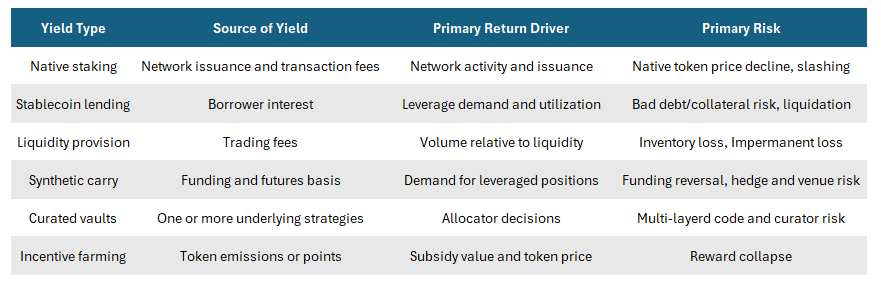
For a chain-agnostic investor, the framework we suggest is to sort yield by what ultimately funds it.
Native staking and top tier DeFi protocol lending yields are usually the place to start.
AMM liquidity provision returns can look attractive but net outcomes are highly dependent on the fact that impermanent loss can dominate fees earned, especially in volatile pairs.
Liquid staking is economically close to native staking but adds code and secondary market discount risk.
Vaults and aggregators improve convenience and sometimes capital efficiency, but they also add many layers of code and curator risk.
Synthetic carry, points farming and leveraged strategies can produce the highest returnsbut they are also the categories most likely to compress suddenly when funding normalizes, emissions decay or airdrop expectations fade. These sources of yield can also end up costing you big depending on what you had to deposit to participate. This would have to be the most actively managed strategy.
What Actually Drives Onchain Yields
The main historical pattern since about 2020 is that yields spiked when crypto native leverage demand, trading activity or token incentives surged. Speculative appetite was the core driver of all yields onchain. In recent years, onchain treasury products have brought yields onchain that are unrelated to crypto’s speculative appetite.
Crypto Market Cycles
When spot and derivatives volumes surge, profitable uses for stablecoins increase, borrow demand rises, perp funding turns positive, liquidations increase, and onchain opportunities become richer. Onchain yields go up because there is significantly more financial activity.
An important consideration: just because yields are higher in a bull market does not mean they are worth it. In may cases there are higher torque opportunities to pursue than high single digit or low double digit stablecoin yields. Taking a portfolio approach to onchain yields and trading is the best approach (i.e. some portion in yield others in onchain trading opportunities).
In bull markets, consider opportunity cost. In bear markets consider downside risk for low yields.
Macro Opportunity Cost
It was commonly said that short-term treasuy yields drive onchain stablecoin lending yields. The actual pass through isn’t really there. Crypto-specific drivers have dominated yields, and its often the case that DeFi stablecoin rates do not adequately compensate for risk versus T-Bills. We believe this is largely because a lot of capital in crypto has to invest in crypto. Risk free rates definitely have some impact (there will be less demand for a DeFi yield as it approaches the risk free rate) but we don’t consider the risk free rate to provide a true “anchor” for yields onchain.
Token Emissions and Incentives
The 2020/2021 cycle was dominated by yield farming and eventually led to the collapse of most tokens as there was far too much supply coming online relative to the demand interested in buying it.
As the market smartened up and yield farming became too efficient we saw the proliferation of points programs, which gave teams the ability to decide distribution mechanics after the fact. Read more on points program dynamics below.
The Yield Compression Problem
The issue with onchain yields (and an onchain economy that is circular/closed off to tradfi markets more broadly) is that high onchain yields contain the seeds of their own decline.
For example, suppose a lending market has $100 million supplied, $80 million borrowed and borrowers paying 8%. New lenders see the attractive rate and deposit another $100 million. If borrowing demand does not change, utilization falls from 80% to 40%. The interest rate paid to suppliers declines.
Yield is highest when capital is scarce. Once an opportunity becomes safe, easy and widely distributed, capital enters until the excess return disappears.
In January 2024 we wrote our first post on Hyperliquid, calling it a farming opportunity (congrats to all the multi-millionaires minted from that post). At the time Hyperliquid’s HLP market making vault was returning a 284% APR (annualized based on 30-day returns) and had only $19 million of capital in it. Today it has nearly $300 million in TVL and produces a single digit return at best. In 1H 2025 during bullish conditions HLP peaked at over $500 million TVL and yielded ~11% annualized.
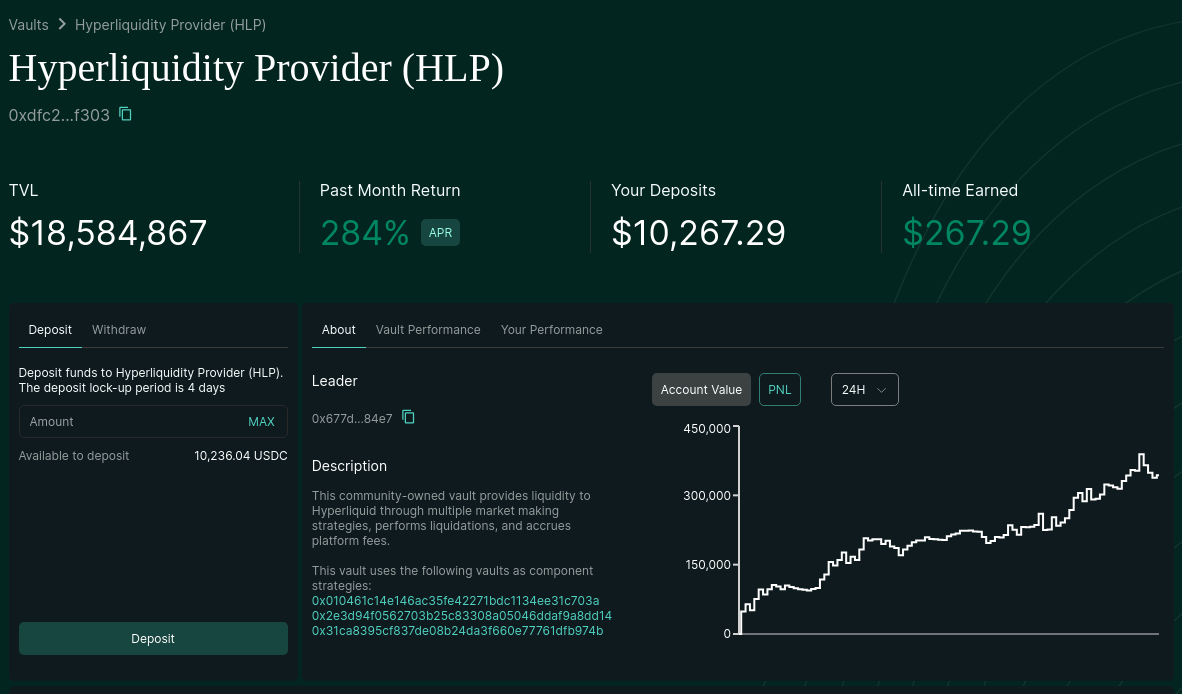
All that is to say, when you find a truly asymmetric yield farm you get aggressive. Until then, be cautious with your capital and make sure you understand the risk/reward profile.
Scarce capital alone does not mean yields are worthwhile. There has to be underlying, organic demand. Organic yield comes from a real user paying for a useful service and can be long-term sustainable as long as the project keeps growing. Inorganic yield comes from a protocol incentivizing people to deposit and is temporary. Inorganic yield lasts only as long as someone is willing to fund the subsidy. As rewards decline the users/depositors pull capital.
Note that organic and inorganic does not mean safe or unsafe. Organic yields can be high because people are taking extreme risks or because markets are temporarily stressed (e.g. borrowers may pay 20% during a speculative frenzy).
How to Evaluate DeFi Yields
You should now understand the various tradeoffs of different yield sources. Below is a framework you can use when looking at new opportunities. We suggest breaking each yield into 5 layers.
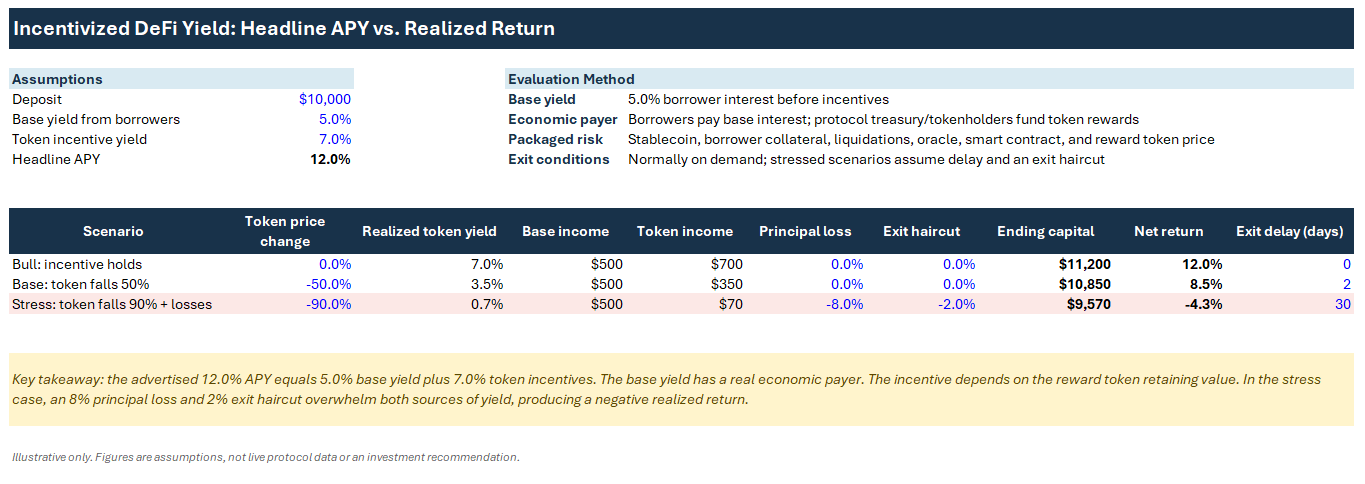
Base Yield: What is the return produced without token incentives or temporary subsidies? (good/ethical projects will show the breakdown directly on the vault interface)
Economic Payer: Who is the player on the other end paying the yield and why are they willing to pay? Is it a corporate entity, other protocol, leveraged trader, DEX user, etc
Packaged risk: Understanding the many layers of protocols, collateral assets, entities, and trading venues will help you stay out of situations that have high blow up risk. In 2022 multi-billion dollar crypto companies were packaging and placing risk across the sector which led to their eventual implosions
Exit conditions: When can your position be redeemed, and are there cases where your capital could be trapped?
Expected loss: What could cause principal loss, how severe could it be and how frequently might it occur? A 12% APY is unattractive if there is a 10% annual chance of losing half your capital
The yield you are receiving should compensate you for the risks you are taking on. Below you can see some modeled out returns for an illustrative yield farm where you deposit a stablecoin and earn a base yield from borrowers plus an incentivized token yield. Note that for new/untested protocols where a 7%+ token yield is actually more likely, you would want to model in far more aggressive assumptions around principal loss and factor in risk of a total zero.
*We will send out the excel backup to this exhibit for paid subs to use on Thursday so you can plug and play
For those on the hunt for onchain yield, make sure you diversify your risk and don’t put the entirety of your crypto capital into a single vault (especially if the protocol hasn’t been battle tested over multiple cycles).
Don’t confuse a smooth interface and well-known exchange brand with a simple investment.
Safe, easy and high yield rarely coexist for long. When an opportunity offers all three your first assumption should be that one of them has been misunderstood. Only after doing more research (or asking us directly in our Paid Q&As!) should you determine whether you’ve found an opportunity with genuine edge.
Want more in-depth crypto insights from our seasoned team? Upgrade to the paid sub.
Paid subscribers also get access to:
All of our past posts
Weekly Deep Dive Report
A comprehensive bi-weekly DeFi Roundup
Bi-weekly Q&A sessions with our team
Until next time..

Disclaimer: None of this is to be deemed legal or financial advice of any kind. These are opinions from an anonymous group of cartoon animals with Wall Street and Software backgrounds.
We now have a full course on crypto that will get you up to speed (Click Here)
We offer the Prediction Markets module on a standalone basis (Click Here)
Security: Our official views on how to store Crypto correctly (Click Here)