Primer on Interest Rates
Level 2 - Value Investor

Welcome Avatar!
The Federal Open Market Committee is meeting this week to decide one of the most important benchmarks in all of finance - the US dollar interbank lending rate, known as the Federal Funds Rate.
Most of our readers will already know that interest rates faffect pricing in risk assets like crypto. Today we’re taking a deeper dive into the nuances beyond risk on/risk off.
First, an important point which doesn’t apply in the same way to other asset classes. USD interest rate changes flow directly through to crypto industry cash flows due to the yield earned on stablecoin reserves. And some of this yield is now shared with platforms and chains.
After reading this article you’ll understand the finance 101 and be able to identify investments which have a rates component (e.g. CRCL, HYPE). We’ll be taking a deeper dive into CRCL on Thursday for paid subscribers.
Rates 101 (skip if finance background)
Which Rates do Central Banks Set?
Central banks typically set the rate banks pay to borrow from each other overnight, and sometimes the rate banks pay to borrow from the central bank where permitted. The US Federal Reserve does not directly set the prices of government or corporate bonds, mortgage rates, or credit card interest.
However the price of money - in whichever context - is best understood as a spread above the “risk free rate” (RFR) to account for the difference in risk between the relevant loan and lending to the government.
The closest thing to a risk-free return is lending to the government by purchasing short term treasury bills (or investing in an instrument, like a bond ETF, which owns treasury bills).
Loans to government are deemed risk free as the government can always issue money to repay its debts in nominal terms. However printing money to pay interest on debt can be inflationary, and it’s only the return of the nominal sum - not the equivalent purchasing power - which is guaranteed. Bond holders therefore have an eye on inflation and real rates (see below).
The RFR is a floor - what you can earn for taking no risk. It would never be rational to lend elsewhere for a lower rate of interest.
The Federal Funds Rate currently sits at 3.50%-3.75%. Every other investment needs to justify its return over the risk free rate against the risk it adds. In a high interest rate environment other investments need to offer a higher reward to attract investments. In a zero interest rate environment a corporate bond yielding 6% may be attractive. At 2.25% above the RFR the same 6% bond will be less attractive.
These comparisons aren’t limited to the bond market - equities, real estate, and other asset classes like crypto compete for capital with risk-free debt instruments. This is why there’s a general rule of thumb that the higher the risk free rate, the worse for other risk assets. Lowering the risk free rate forces capital to take risk to earn yield.
Nominal and Real Rates
Risk assets respond to the difference between the nominal interest rate for a currency and the inflation rate of the relevant economy. In the US, headline inflation is currently 4.2% while the Federal Funds Rate is 3.50%–3.75%, so the real rate is actually slightly negative (around -0.6%) even though nominal rates look high. This is an example of negative real rates due to high inflation (energy prices).
During zero interest rate policies in G7 economies recently, real rates were negative due to monetary policy (0-1% interest rates with ~2% inflation). “High interest rates” can be a headline while the real rate is only slightly positive or even negative.
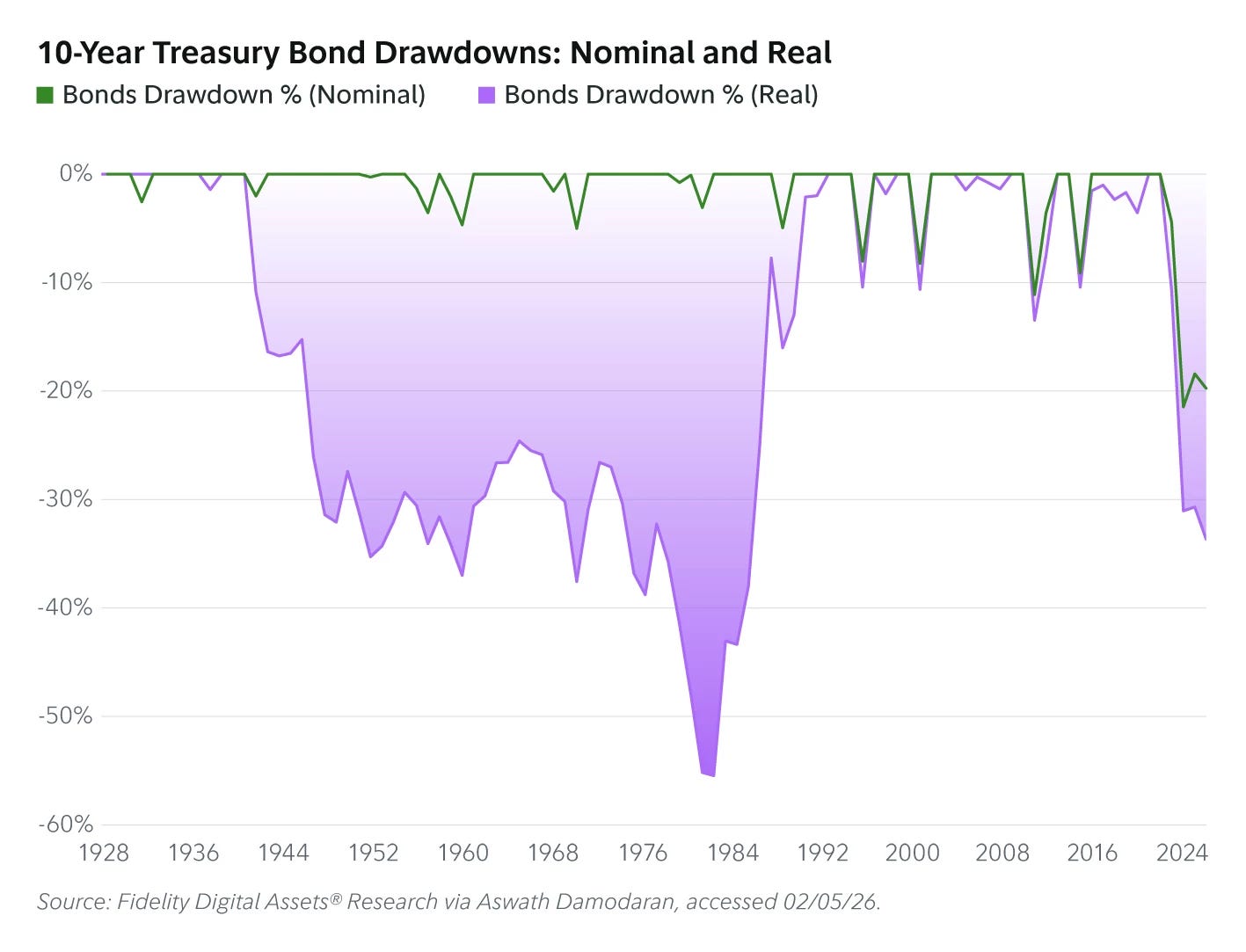
Trying to understand rates without considering inflation and the concept of real rates leads to common misunderstandings. When interest rates are hiked to control rising inflation, real rates may stay relatively unchanged but the rising nominal rates cause large drawdowns for long term bond investors.
Crypto Sensitivity to Interest Rates
After the 2022 bear market the IMF did some research on crypto sensitivity to interet rates:
Crypto assets vary substantially in their design and value propositions, yet their prices largely move together. A single crypto factor can explain 80% of the variation in crypto prices, and has become more correlated with the global financial cycle since 2020, particularly with technology and small-cap stocks. We provide evidence that such correlations are driven by the increased presence of institutional investors in crypto markets, which has made the risk profile of the marginal equity and crypto investors increasingly similar. Furthermore, crypto markets are very sensitive to US monetary policy, with a monetary contraction significantly reducing the crypto factor, similarly to global equities. Source: IMF WP/23/163 “The Crypto Cycle and US Monetary Policy”
Rates and Duration
An asset’s price should be equal to the present value of expected future cash flows (or future resale value) discounted at a rate that includes the risk-free rate plus a risk premium. When the Fed raises rates the risk-free component of every discount rate rises, lowering present values.
The concept of duration shows why the timing of cash flows from an asset affects sensitivity to interest rates. Duration is the weighted average time before receiving a portion of cash flows from an asset. The mechanism to derive the present value of future cash flow is called discounting and it compounds with time.
The present value of the right to receive $100 in 1 year depends on the RFR. Why? If you could invest $90 now a 2% interest you would prefer the right to receive $100 next year. If you could invest $90 at 20% interest you would prefer to receive $108 not $100.
Autist note: To find the present value you divide $100 by (1 + RFR ) raised to the power of the duration - so the duration (in years) is an exponential input
Now do the same for $100 in 10 years.
At 2% that’s 1.02 ^ 10, roughly 1.22. The right to receive $100 a decade out is worth roughly $82 today. $18 below face value. At 20% it’s 1.20 ^ 10, dropping the present value of $100 to around $16.
Back in the 1 year example the gap was $98 vs $83. At 10 years the difference blows out to $82 vs $16. The longer the cash flow sits in the future, the more the rate decides its value. Although this is a bond concept you can classify equities into buckets based on when their cash flow is expected to arrive. Mature, stable companies will throw off regular cash, so short duration. High growth companies may have no cash flows at all but are projected to dominate their markets in the future. Their return is projected to arrive far in the future, so long duration.
Why Bitcoin is Different
Bitcoin pays no coupon or dividend and has no cash flow (fees are paid to use the network but consumed by security needs). It’s essentially an infinite duration asset / pure “store of value” play. Various approaches to valuation include monetary/SOV premium + high discount rate and build a DCF; assess scarcity (the famous Stock to Flow chart), or assess market penetration / estimate CAGR.
Note the opportunity cost of holding a non-yielding asset like gold or Bitcoin depends on the RFR, or more accurately on the real rate (e.g. US inflation protected treasuries).
Although Bitcoin should be extremely rate sensitive, like a perpetuity, based on duration analysis alone there are other factors which dominate its pricing. Bitcoin carries a huge volatile risk premium and its value depends on shifting expectations about its utility and terminal value. Empirically Bitcoin prices change with liquidity and risk appetite rather than responding immediately to rate changes.
Debunking Common Myths
Rate Cuts Always Bullish: If the market consensus favors a rate cut (e.g. 95% odds) then this should be “priced in” ahead of the cut. The cut can even prove to be a “sell the news” event. Rate cuts can be more bullish when not expected or when larger than expected (e.g. the 50bps cut vs 25bps expectation in September 2007). It also matters why rates are being cut. If the central bank analysis of inflation, labor market, and other economic data leads to the conclusion that the economy is entering a recession this isn’t bullish. A rate cut late in a business cycle does not abolish the cycle. (October 2007 was a major market top) Even aggressive central bank interventions through interest rate policy and otherwise have failed to control declines in asset prices. An economy can be fragile from high interest rates (debt burden) and simultaneously facing inflation due to real world disruption of supply chains - a rate cut in this context might be an indicator to reduce exposure to risk assets.
Higher Rates Are Bad: Aggressive rate hikes to control inflation were very bad for crypto in 2022. Today we have relatively high nominal rates and bifurcation between long duration tokens (rates sensitive) and crypto businesses (stablecoin issuers, stablecoin revenue partners) which benefit from higher rates. Yield on reserves backing stablecoins cash flow billions of dollars a year back into crypto businesses. This money is then spent on crypto acquisitions, investment in Bitcoin (and gold), or returned to share/token holders.
Bitcoin as a Price Inflation Hedge: Although this narrative used to have widespread mindshare we now have data to refute it. The 2022 bear market in risk assets, including Bitcoin, was driven by a series of aggressive interest rate hikes designed to dampen inflation. Bitcoin traded like a tech stock, not an inflation hedge. And after the highest inflation in decades Bitcoin trades around the same price as the 2021 record high. Similar criticisms can be made of the “digital gold” / store of value thesis. What’s more accurate is Bitcoin as a money supply inflation hedge - the Bitcoin price covaries with the M2 money supply of advanced economies with an r-squared of 0.87:
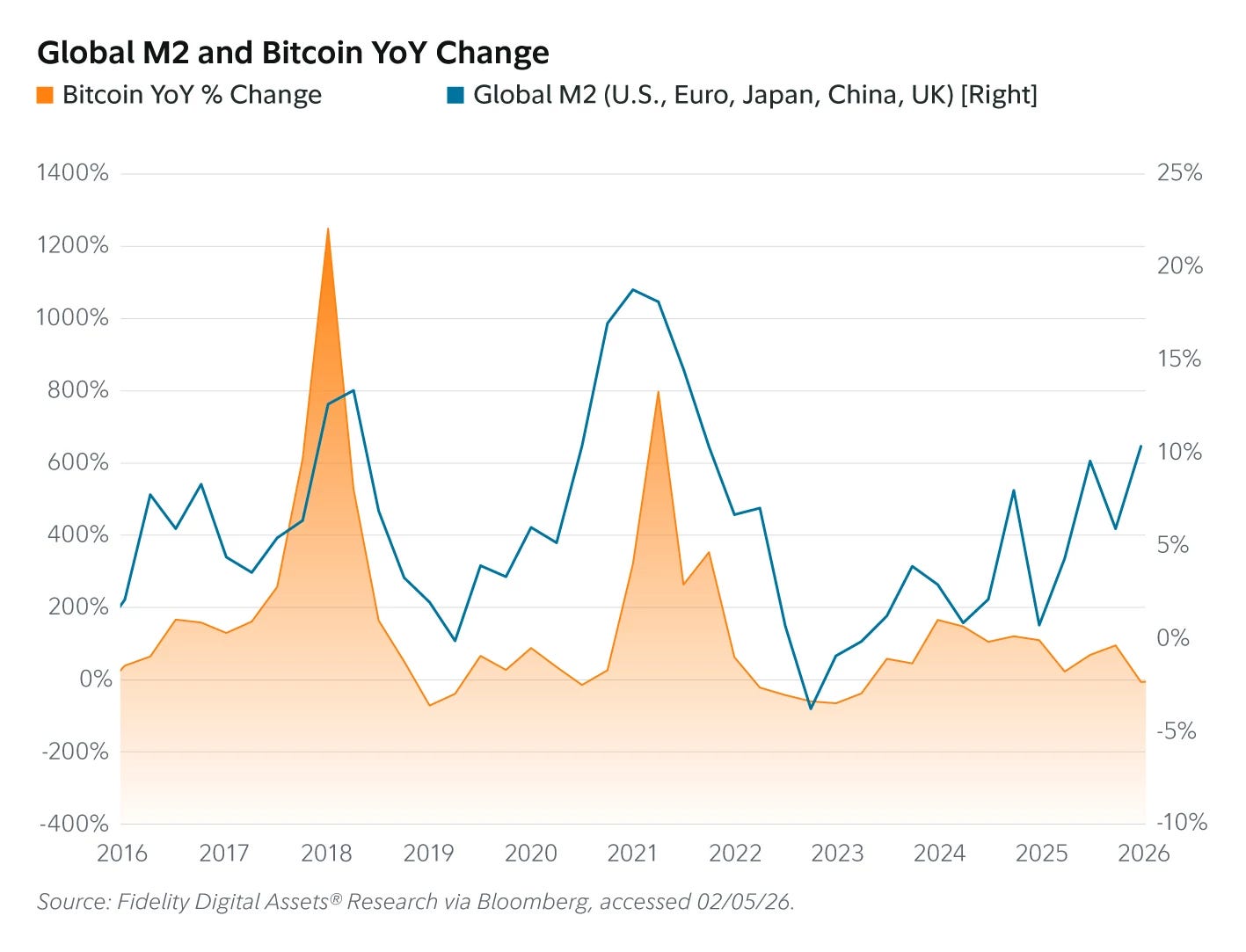
Note the apparent lag and how M2 has been increasing since 2024 but Bitcoin price has not yet recovered.
Correlations: Crypto bulls have expected Bitcoin to “decouple” from macro and other risk assets, with the possibility that tokens experience tremendous gains while other asset classes fall in value. So far this hasn’t happened, and correlations aren’t stable. Sometimes Bitcoin has been highly correlated to tech stocks, and during times when it has decoupled it has suffered a painful ~50% drawdown while stocks put in double digit annual gains and trade at record highs. There’s no durable rule governing correlation with other asset classes - cherry picking examples is the classic “data dredging” problem.
Rates & Stablecoins
Stablecoins are the DeFi equivalent of a money market fund.
Reserves sit in bank deposits and short term treasuries, the yield on those deposits is typically internalized by the issuer. However market forces are pressuring issuers to share this revenue stream with platforms, blockchains, other ecosystem partners and potentially with stablecoin holders directly (subject to regulatory approval).
We therefore don’t just consider the revenue accruing to the issuer, but how this is shared out with other entities in the crypto ecosystem.
Issuers have a long position on rates. The majority of CRCL’s revenue comes from yield. CRCL’s valuation should therefore be very sensitive to changes in rates.
Hyperliquid’s HYPE token also has a long rates factor:
interest rates increase → CRCL revenue on reserves increases → ~90% share of reserve yield for USDC on Hyperliquid paid to the L1 → revenue deployed to buyback and burn HYPE token
Paid subscribers can access our detailed coverage on Hyperliquid’s USDC revenue sharing deal and we’ll cover Circle CRCL in depth on Thursday.
If you’re long the crypto sector sign up to be a paid subscriber today to stay on top of the market without spending all day on crypto twitter.
Paid subscribers also get access to:
All of our past posts
Weekly Deep Dive Report
A comprehensive bi-weekly DeFi Roundup
Bi-weekly Q&A sessions with our team
Until next time..

Disclaimer: None of this is to be deemed legal or financial advice of any kind. These are opinions from an anonymous group of cartoon animals with Wall Street and Software backgrounds.
We now have a full course on crypto that will get you up to speed (Click Here)
We offer the Prediction Markets module on a standalone basis (Click Here)
Security: Our official views on how to store Crypto correctly (Click Here)